The Best 13.8V Power Supply for Ham Radio UK: A 2026 Buyer's Guide
A no-nonsense guide to choosing a 13.8V 30A regulated power supply for your ham or CB radio base station. Covers SMPS vs linear, noise performance, and what actually matters when you're running HF from a UK shack.
What Is a Switching Power Supply?
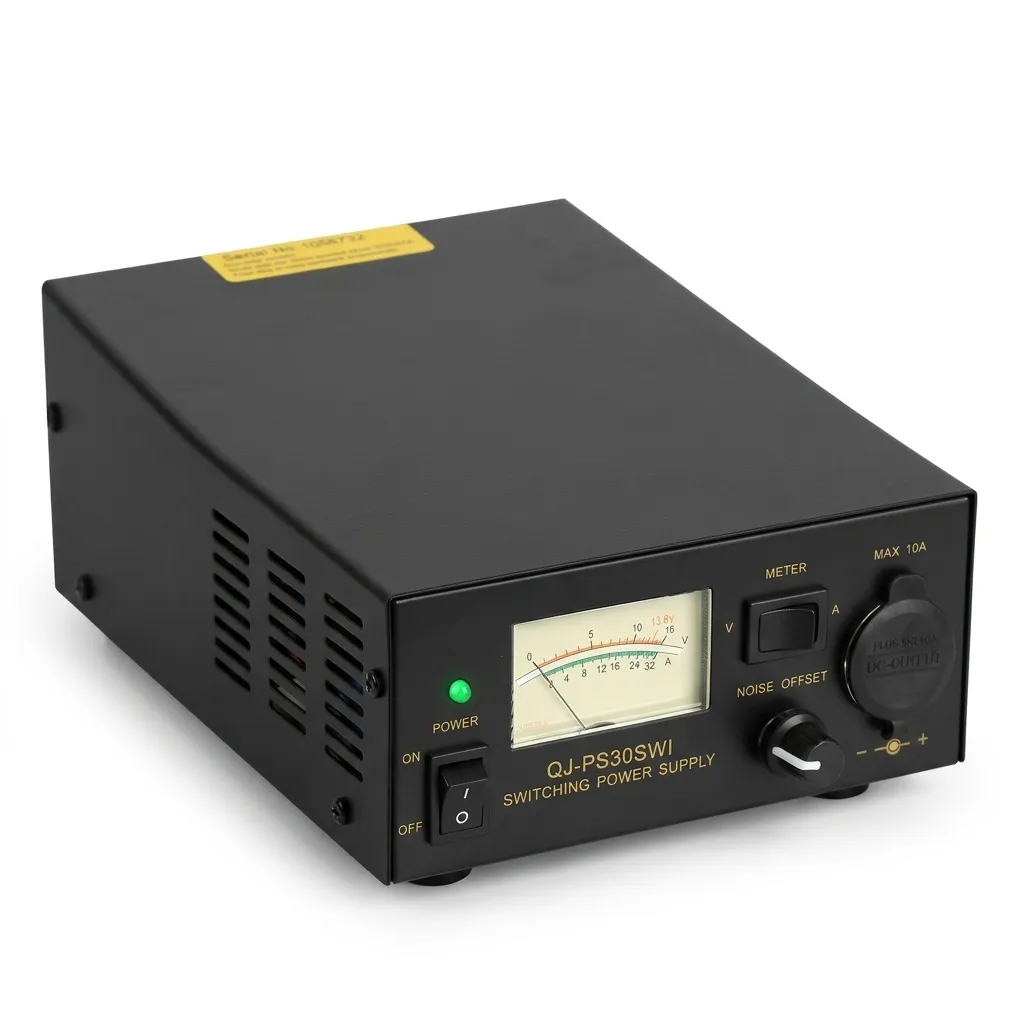
A switching power supply (SMPS) converts mains AC to regulated DC by rapidly switching transistors on and off — typically at frequencies between 50kHz and 500kHz. That's the short answer. The longer version involves pulse-width modulation, high-frequency transformers, and feedback loops that keep output voltage rock-steady under varying loads.
Why does this matter for radio operators? Because the switching frequency can generate harmonics that bleed into your receiver. Cheap units are notorious for it. A well-designed low noise switching power supply, though, uses filtering and shielding to suppress those harmonics below the noise floor of your radio.
If you have just passed your Foundation licence and bought your first 100W HF rig, perhaps a used IC-7300, you may have opened the box to find no power supply included. That is the moment most UK newcomers start working out what a 13.8V supply actually has to do. Many operators begin with a heavy old linear transformer (7kg or more) before moving to a modern SMPS and never looking back; the weight saving alone is worth it when you are carrying kit upstairs to the shack.
Why 13.8V at 30A? The Radio Standard Explained
The 13.8V figure isn't arbitrary. It matches the nominal voltage of a fully charged 12V lead-acid battery under alternator charge — the same voltage your mobile rig sees in a vehicle. Standardising on 13.8V means your base station transceiver operates identically whether it's powered from a car battery or a regulated 13.8V DC power supply for radio use.
And 30A? A 100W HF transceiver draws roughly 20–22A on transmit. That 30A rating gives you headroom. You never want a PSU running at 100% capacity continuously — that's how components cook themselves.
The Maths on Power Draw
At 13.8V and 30A, you've got 414W of available DC power. A typical 100W SSB rig peaks around 20A during voice peaks but averages closer to 8–12A. That headroom keeps the supply cool and extends its lifespan considerably. Running a bench PSU 13.8V 30A at 60–70% load is the sweet spot.
SMPS vs Linear: Which Is the Best 13.8V Power Supply for Ham Radio UK?
This debate has raged on amateur radio forums for decades. Here is an honest take after years of both types in UK shacks.
Linear Power Supplies
A 30A linear power supply 13.8V uses a large mains transformer, bridge rectifier, and series-pass regulator. Dead simple. Virtually zero RF noise. But they're heavy (8–14kg for a 30A unit), run hot, and cost more per amp. If you're chasing weak DX signals on 160m, a linear is still hard to beat for absolute noise floor. That said, the gap has narrowed dramatically.
Switch-Mode Power Supplies
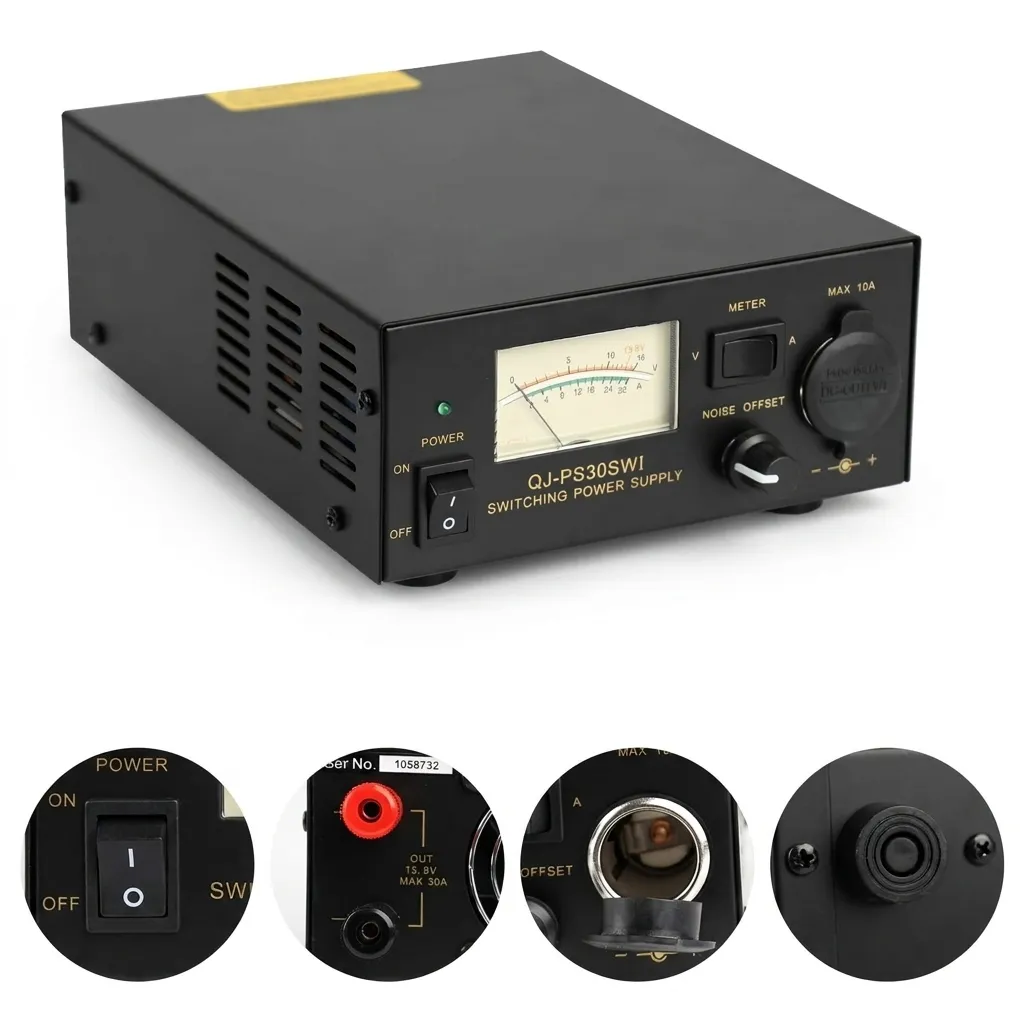
A 30A switch mode power supply 13.8V weighs 2–4kg, runs cooler, and costs £60–£130 for a decent unit. The trade-off used to be noise. Used to be. Modern designs with Noise Offset Control can shift switching harmonics away from amateur bands. In UK shack use, the best of these units can be effectively indistinguishable from a linear on 20m and 40m. For a deeper comparison, there's a solid breakdown on SMPS vs linear PSU performance for radio.
So what's the catch? Cheap SMPS units — the £30 specials from marketplace sellers — often lack proper filtering. You get what you pay for. A quality ham radio power supply 13.8V UK unit with proper EMC compliance is worth the extra spend.
Why Low Noise Matters for HF and VHF Operation
RF noise from a power supply shows up as a buzzing or whining on receive. On SSB it sounds like a rough hum layered over signals. On CW it can mask weak stations entirely. The noise typically appears as discrete spurs every few kHz across the HF spectrum.
A properly designed low noise switching power supply addresses this through three mechanisms:
- Input filtering: Common-mode chokes and X/Y capacitors on the mains side prevent conducted emissions feeding back into your house wiring
- Output filtering: LC networks on the DC output smooth ripple to below 30mV peak-to-peak
- Noise Offset Control: Shifts the fundamental switching frequency so its harmonics fall between amateur bands rather than on them
That last feature is genuinely clever. By adjusting the switching frequency by just a few kHz, harmonics that would land on 7.1MHz or 14.2MHz get pushed into gaps between allocations. On a rig like the IC-7300, switching Noise Offset on rather than off can lift a switching birdie clean off your calling frequency, and UK operators regularly report a clearly audible drop in noise on 40m. If your supply has that setting, it is worth toggling: it takes seconds and the difference is usually obvious.
On the compliance side, power supplies sold in the UK must meet electromagnetic compatibility requirements. The UK Government's EMC guidance outlines the regulatory framework that applies to these products.
What to Look for in the Best 13.8V Power Supply for Ham Radio UK
Not all 13.8V 30A supplies are created equal. Here's what separates a decent unit from a proper piece of kit.
Voltage Regulation
Look for ±0.1V regulation or better. Your radio expects 13.8V — not 12.9V under load or 14.5V at idle. A 13.8V regulated power supply UK unit should hold steady from zero to full load. Anything drifting more than ±0.3V under load is suspect.
Current Rating (Continuous vs Peak)
Read the specification carefully, because continuous and peak ratings are not the same thing. A 100W HF transceiver peaks at roughly 20-22A on transmit but, on SSB or CW, averages far less between overs. A supply rated around 20A continuous with a 30A peak, the way the Jaogau PS-30A is specified, comfortably powers a 100W rig for normal HF operating. Where you want more continuous headroom is sustained high-duty work: long FM, RTTY or FT8 sessions at full power, which sit closer to a supply's continuous figure for minutes at a time.
Protection Circuits
At minimum: over-voltage protection (OVP), over-current protection (OCP), short-circuit protection, and thermal shutdown. These aren't optional extras — they protect your £1,000+ transceiver. The BSI standards framework covers the safety requirements these products should meet.
Build Quality and Connectors
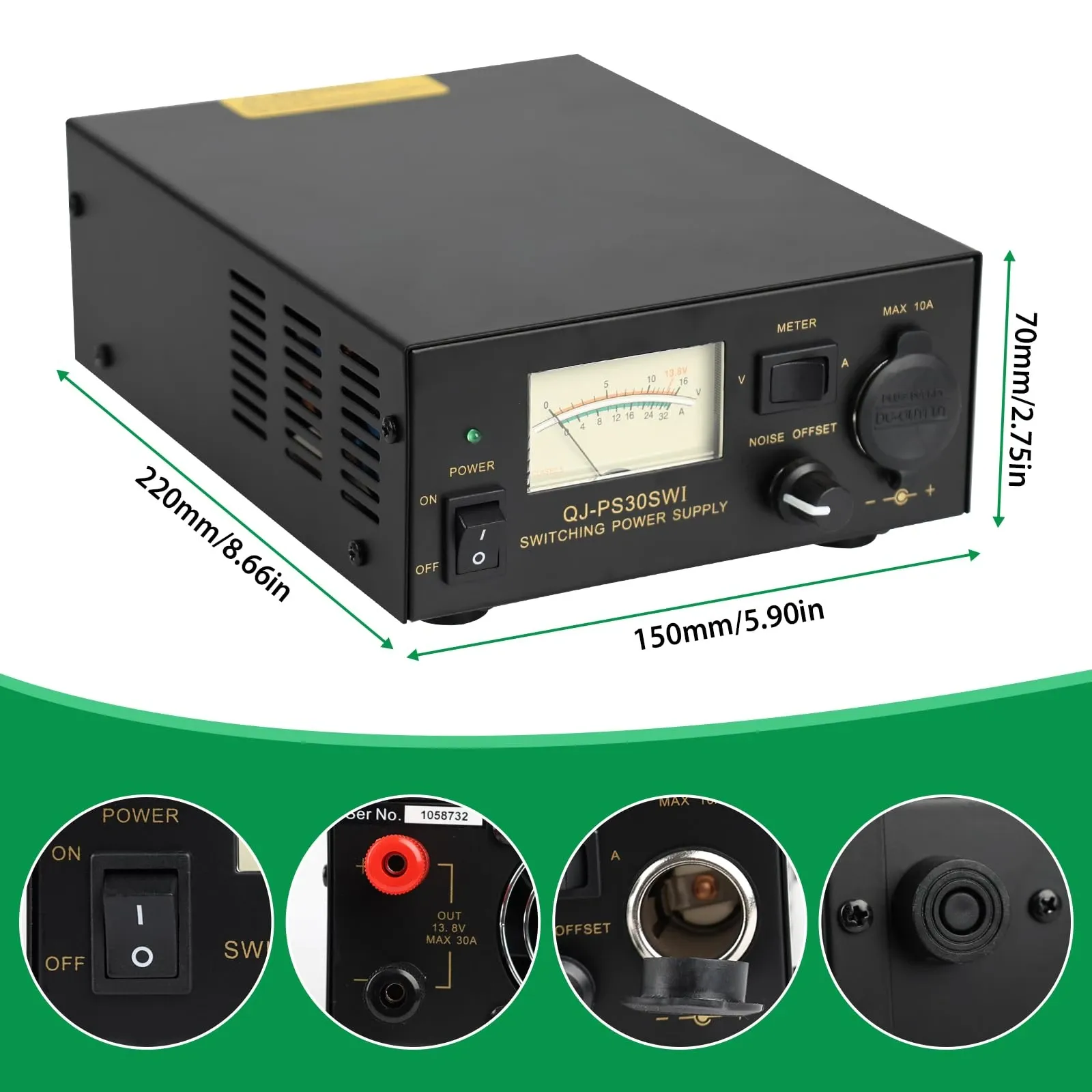
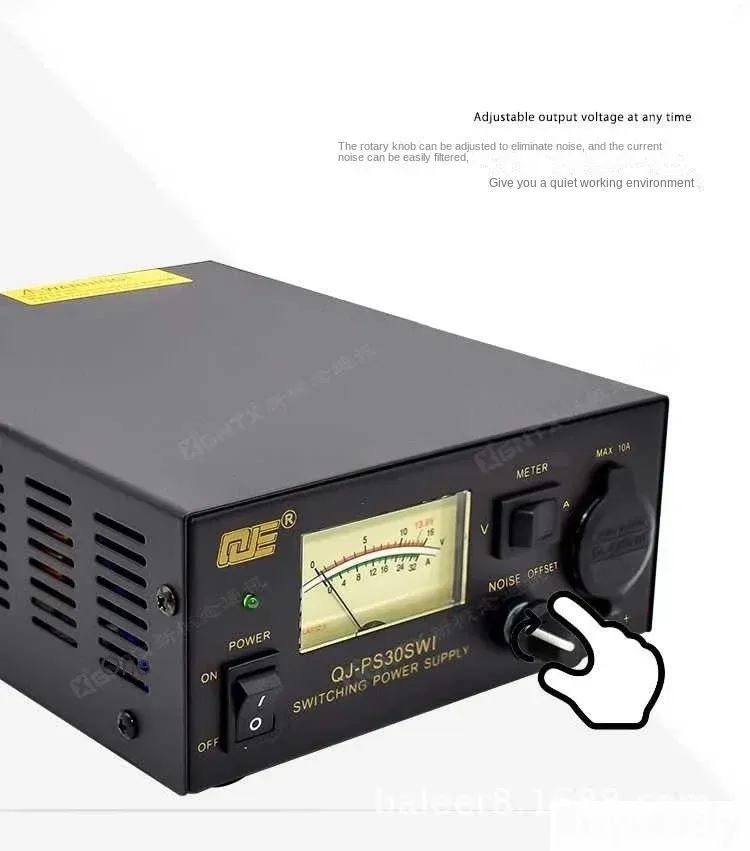
Anderson Powerpole connectors or heavy-duty binding posts rated for 30A+. Flimsy banana plugs won't cut it at these currents. A front-panel cigarette lighter socket (10A rated) is handy for charging handhelds or running accessories.
Fan Noise
Temperature-controlled fans are essential. A fan running at full blast constantly is maddening during quiet evening operating. The best units stay silent below 50% load and ramp up gradually. My current supply doesn't spin the fan at all during receive — only kicks in during extended transmit periods.
For more on choosing between compact and traditional form factors, linear vs switching PSU comparison guide covers the practical differences well.
UK Market Comparison: 13.8V 30A Bench Power Supplies (June 2026)
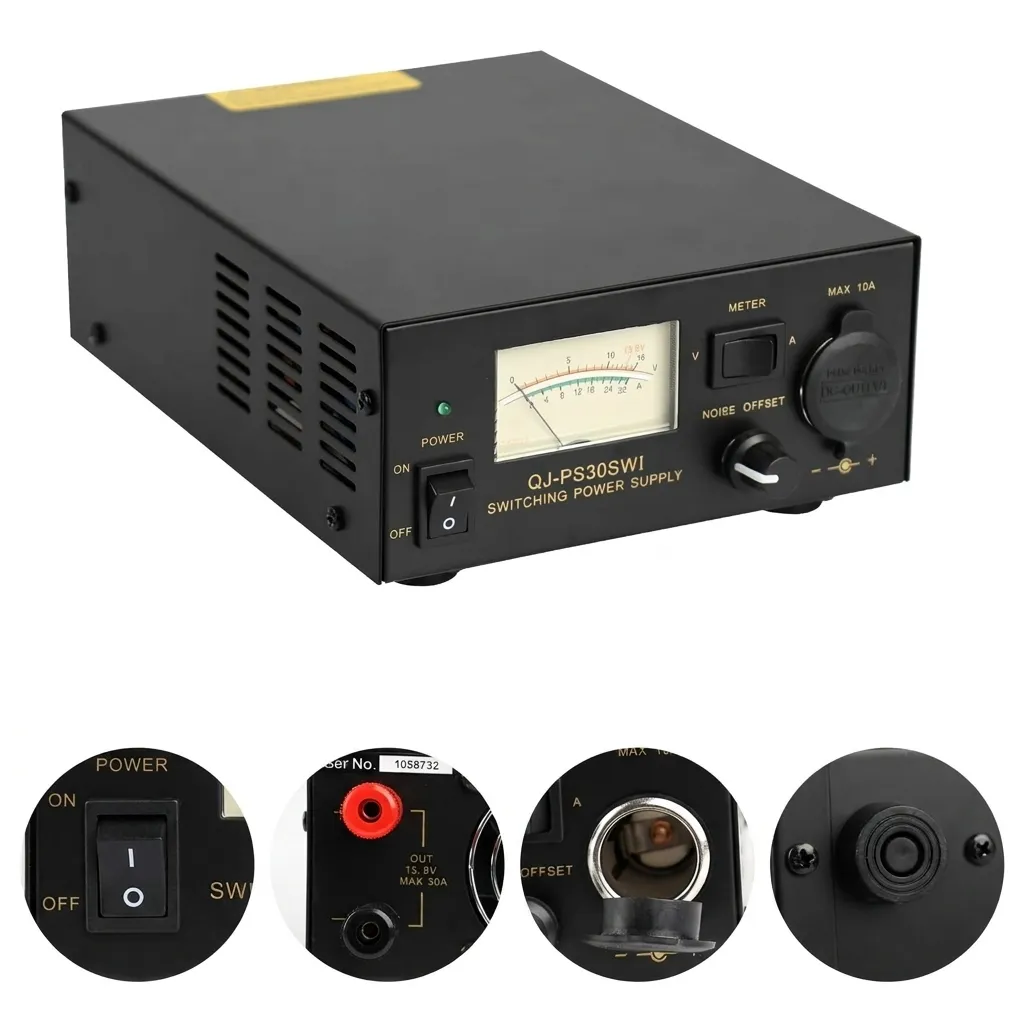
I've pulled together specs from units currently available to UK buyers. Prices reflect typical online retail as of spring 2026.
| Feature | Budget SMPS (£40–£60) | Mid-Range SMPS with Noise Offset (£80–£130) | Linear PSU (£180–£280) |
|---|---|---|---|
| Typical Weight | 1.8–2.5kg | 2.5–3.8kg | 8–14kg |
| Output Ripple | 80–150mV p-p | 20–40mV p-p | 5–15mV p-p |
| Noise Offset Control | No | Yes | N/A (no switching noise) |
| Efficiency | 80–85% | 85–92% | 50–60% |
| Fan Noise | Always on | Temperature-controlled | Often fanless |
| OVP/OCP/SCP | Basic | Full suite | Varies |
| Cigarette Socket | Rarely | 10A front panel (common) | Rarely |
| UK Price Range | £40–£60 | £80–£130 | £180–£280 |
| Best For | VHF/UHF FM only | All-band HF/VHF/UHF | Weak-signal HF, EME |
Honestly, for most operators running SSB or digital modes on HF, the mid-range SMPS category hits the sweet spot. You're getting 90%+ of linear performance at a third of the price and a quarter of the weight. The best 13.8v power supply for ham radio UK buyers will find sits firmly in that £80–£130 bracket for a quality 13.8V 30A bench power supply with proper noise management.
Setup Tips From the Shack
A few practical things are worth getting right when you set a supply up in a UK shack.
Cable Runs and Voltage Drop
Keep DC cables short and fat. At 20A, a 2-metre run of 2.5mm² cable drops about 0.3V. That might not sound like much, but your radio's already at the bottom of its operating range at 13.5V. Use 4mm² or 6mm² cable for runs over 1 metre. Crimp properly — don't just twist and tape.
Grounding
Bond your PSU chassis to your station earth. A separate ground rod or connection to your house's main earth terminal works. This reduces common-mode noise and gives fault currents somewhere safe to go. Don't skip this step.
Placement
Keep the PSU at least 1 metre from your antenna feedpoint and away from your receiver. Even a quiet supply radiates something at close range, so a lower shelf with the radio above it works well.
Check your mains supply too. If you're running off a ring main shared with a fridge or washing machine, you might pick up interference through the mains. A dedicated spur or at minimum a good mains filter helps. For guidance on AC to DC conversion at 13.8V, that's covered separately.
Frequently Asked Questions
What is the best 13.8V power supply for ham radio in the UK?
The best 13.8V power supply for ham radio UK operators in 2026 is a mid-range SMPS with Noise Offset Control, priced between £80–£130. These units deliver a genuine 30A peak (around 20A continuous), output ripple below 40mV peak-to-peak, temperature-controlled fans, and full protection circuits — covering HF, VHF, and UHF without audible interference on receive.
Can I use a switching power supply for HF radio without interference?
Yes, modern SMPS units with Noise Offset Control shift switching harmonics away from amateur bands. Quality units produce less than 30mV ripple and are effectively silent on HF receive. Budget units below £50 often lack adequate filtering and will cause problems on 40m and 80m particularly.
Why do ham radios need exactly 13.8V?
13.8V matches the voltage of a vehicle electrical system under alternator charge. Transceivers are designed to operate between 13.2V and 14.0V for rated output power. Below 12.5V, most rigs reduce transmit power automatically. A regulated 13.8V DC power supply ensures consistent full-power operation at the base station.
Is a 30A power supply enough for a 100W transceiver?
A 100W HF transceiver draws approximately 20–22A at full power on SSB. A 30A supply provides 35–50% headroom, which keeps the unit cool and extends component life. For FM modes at 100W continuous duty, 30A is adequate but leaves less margin — consider a 40A unit for heavy FM or digital mode use.
How heavy is a 13.8V 30A bench power supply?
A switch-mode 13.8V 30A bench power supply typically weighs 2.5–3.8kg. Linear equivalents weigh 8–14kg for the same current rating. The weight difference is significant for portable operation or if your operating desk has limited load capacity. SMPS units measure roughly 200×100×150mm.
Do I need a linear power supply for weak-signal work?
Not necessarily. A quality SMPS with Noise Offset Control performs within 2–3dB of a linear supply's noise floor on most HF bands. For extreme weak-signal work like EME (moonbounce) or 160m DXing where every fraction of a dB matters, a linear supply still has a slight edge. For general HF SSB and digital modes, a good SMPS is spot on.
Key Takeaways
- The best 13.8V power supply for ham radio UK operators in 2026 is a mid-range SMPS (£80–£130) with Noise Offset Control and full protection circuits.
- A 13.8V 30A bench power supply provides adequate headroom for any 100W transceiver, with 35–50% margin above typical transmit current draw.
- Modern filtered SMPS units achieve output ripple below 30mV p-p — comparable to linear supplies for all but the most demanding weak-signal applications.
- Weight savings are substantial: 2.5–3.8kg for SMPS vs 8–14kg for linear at the same 30A rating.
- Always use 4mm²+ DC cable for runs over 1 metre to avoid voltage drop below your radio's minimum operating threshold of 12.5V.
- Temperature-controlled fans, Anderson Powerpole connectors, and a front-panel cigarette socket (10A) are features that separate decent units from proper ones.
- Bond your PSU chassis to station earth — it reduces common-mode noise and is a basic safety requirement per HSE electrical safety guidance.
Ready to try Jaogau Bench Power?
View Jaogau PS-30A — £82.90 · Free UK Delivery13.8V · 30A peak · Noise Offset Control · 12-month warranty